
What Is a Wrong Site Surgery Never Event Claim in Illinois?
Surgical Errors That Should Never Happen: Understanding Illinois Never Event Claims
Key Takeaways: A wrong site surgery never event claim in Illinois is a medical malpractice action arising when a surgeon operates on the wrong body part, wrong side, wrong patient, or performs the wrong procedure, errors generally considered highly preventable through site marking, pre-operative verification, and the surgical time-out. Illinois addresses these incidents through facility regulation under the Hospital Licensing Act, mandatory reporting under the Illinois Adverse Health Care Events Reporting Law of 2005 (410 ILCS 522/10-1 et seq.), and administrative fines against ambulatory surgical treatment centers under 210 ILCS 5/10d, but regulatory penalties do not compensate patients or automatically establish negligence. Recovery generally requires a separate civil suit proving a deviation from the standard of care and resulting harm, supported by qualified medical testimony, operative and time-out records, imaging, revision surgery documentation, and economic proof. Illinois also requires a certificate of merit under 735 ILCS 5/2-622, and failure to file it may be grounds for dismissal, though courts often allow an opportunity to amend. Claims by adults are generally governed by a two-year limitations period running from discovery and a four-year statute of repose under 735 ILCS 5/13-212(a), with separate rules for minors and legally disabled persons. Immunity for peer-review participants under 210 ILCS 85/10.2 and confidentiality for quality-review materials under the Medical Studies Act may limit what internal investigative documents are discoverable, but generally do not relieve providers of liability arising from the treatment itself.
A wrong site surgery never event claim is a medical malpractice action brought when a surgeon operates on the wrong body part, wrong side, wrong patient, or performs the wrong procedure altogether. These incidents are classified as "never events" because they are generally considered highly preventable through basic safety protocols such as site marking, pre-operative verification, and the surgical time-out. In Illinois, a patient harmed this way may pursue a civil claim against the surgeon, hospital, or surgical facility, subject to strict procedural requirements including a certificate of merit and filing deadlines that courts generally enforce firmly.
If you or a family member suffered harm from a preventable surgical error in Illinois, the medical malpractice team at PAUL PADDA LAW is prepared to review the surgical records and consult qualified physicians about whether a claim may exist. Call 702-366-1888 or contact us now to discuss what happened in the operating room.
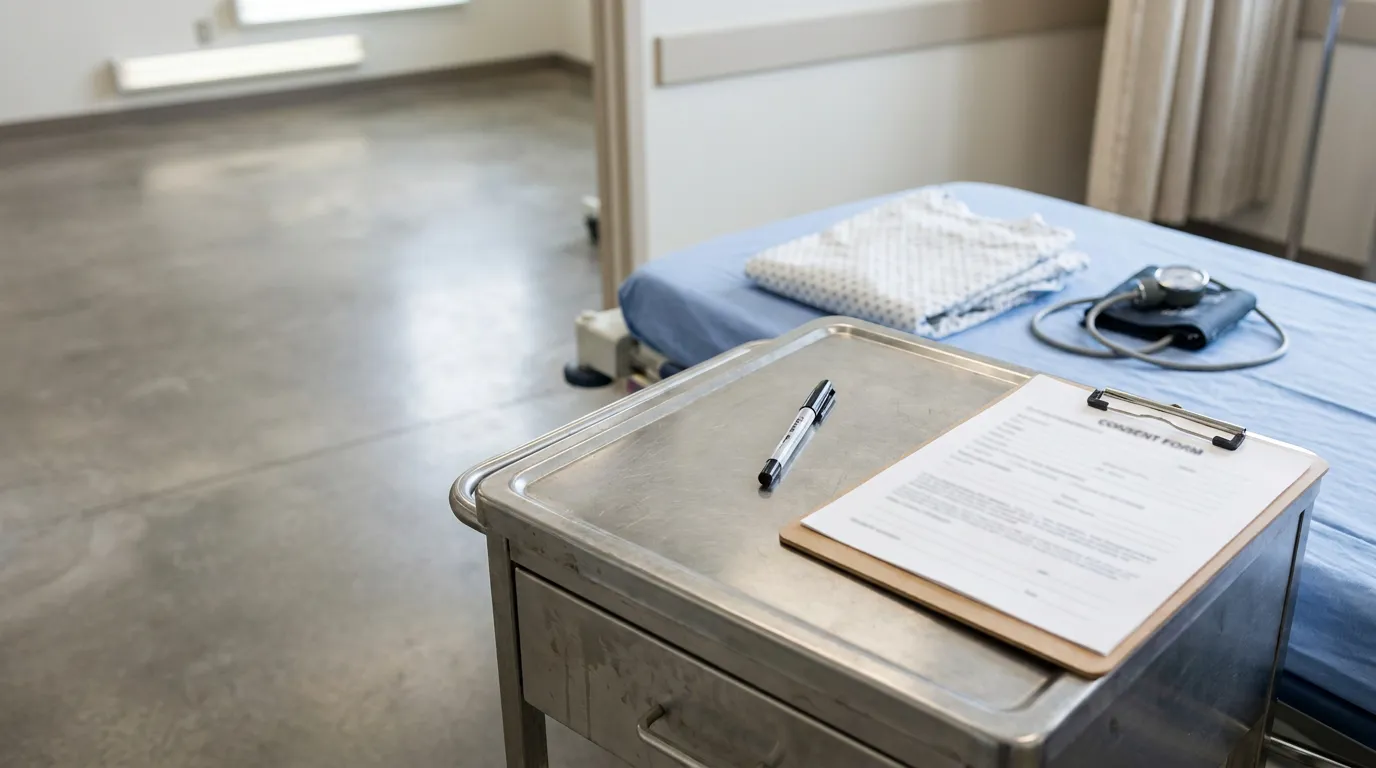
What the Never Event Definition in Illinois Actually Covers
"Never event" is generally a patient-safety classification rather than a standalone cause of action under Illinois law. The term describes serious, largely preventable adverse occurrences that facilities are expected to report and eliminate, including surgery on the wrong site, wrong patient, or wrong procedure. A wrong-site operation may draw both regulatory attention and a potential civil claim, each analyzed independently.
Illinois maintains a dedicated Hospital Licensure Fund created "for the purpose of providing funding for the administration of the licensure program and patient safety and quality initiatives for hospitals, including, without limitation, the implementation of the Illinois Adverse Health Care Events Reporting Law of 2005" under 210 ILCS 85/14.5. That provision, together with the broader Hospital Licensing Act provisions and the separately codified reporting law, shows the state treats never events as a subject of formal quality regulation, but these statutes govern licensure and reporting; they don’t create a private right of action for an injured patient.
Under 210 ILCS 86/5, part of the Hospital Report Card Act, the General Assembly found "that Illinois consumers have a right to access information about the quality of health care provided in Illinois hospitals in order to make better decisions about their choice of health care provider."
Regulatory Consequences Are Separate From Your Lawsuit
Administrative penalties against a facility generally operate independently from any civil claim a patient files. Under 210 ILCS 5/10d, applicable to licensed ambulatory surgical treatment centers, when the Director finds noncompliance with the Act or the Adverse Health Care Events Reporting Law, the Department "may assess a fine of up to $500 per violation per day commencing on the date the violation was identified and ending on the date the violation is corrected." The Director considers "the gravity of the violation, including the probability that death or serious physical or mental harm to a patient will result or has resulted." Hospitals face their own licensure sanctions under the Hospital Licensing Act rather than this section.
That severity-based analysis may map onto catastrophic surgical mistakes. However, a regulatory fine does not compensate an injured patient, and an administrative finding generally does not automatically establish negligence in a civil case. Recovery generally requires a separate lawsuit proving a deviation from the standard of care.
Proving a Wrong Site Surgery Never Event Claim in Illinois
Illinois plaintiffs generally must prove the applicable standard of care, a deviation from it, and that the deviation proximately caused compensable harm. Wrong-site cases may seem straightforward since the error is often documented in the operative report, but liability still depends on qualified medical testimony, causation evidence, and proof of damages.
Key evidence may include:
- Pre-operative consent forms and site-marking documentation
- The surgical time-out record and operating room nursing notes
- Imaging studies and pathology reports showing what was actually operated on
- Corrective or revision surgery records and long-term treatment plans
- Economic proof such as wage loss documentation and life-care planning analysis
💡 Pro Tip: Request a complete certified copy of the hospital chart, including the operative report and anesthesia record, as early as possible. Records can be reorganized over time, and an early certified set may help preserve the original account of what happened.
Informed Consent and Wrong-Site Operations
A wrong-site procedure may mean the patient did not consent to the operation actually performed. Illinois recognizes patient rights in certain contexts, reflected in the Medical Patient Rights Act, which under 410 ILCS 50/3.1 addresses the right of a patient who is the subject of a research program or an experimental procedure (as defined under the Hospital Licensing Act) "to receive an explanation of the nature and possible consequences of such research or experiment before the research or experiment is conducted, and to consent to or reject it."
In many wrong-site cases, counsel evaluates both a negligence theory and a lack-of-informed-consent theory. Illinois courts treat informed consent as a form of professional negligence ordinarily requiring expert testimony on disclosure standards, and some courts have declined to allow a separate consent count where the alleged harm is fully captured by the negligence claim. Whether both theories survive depends on the facts, pleadings, and how the court characterizes the claim.
Peer Review Protections May Not Bar Your Claim
Illinois grants participants in hospital peer-review and quality activities broad immunity, but that immunity generally has meaningful limits. Under 210 ILCS 85/10.2, hospitals and staff generally are not "liable for civil damages as a result of the acts, omissions, decisions, or any other conduct, except those involving wilful or wanton misconduct" in the peer-review context. Notably, the same section states "nothing in this Section shall relieve any individual or hospital from liability arising from treatment of a patient."
That carve-out may matter. Separately, the Medical Studies Act (735 ILCS 5/8-2101 et seq.) makes many internal quality-review materials privileged from discovery, although Illinois courts have held the privilege does not cover underlying medical records or information generated before a peer-review process begins. Patients should not assume peer-review confidentiality forecloses recovery, though it can complicate what documents become available.
The Certificate of Merit Requirement Every Illinois Case Faces
Illinois generally requires a plaintiff, or the plaintiff’s attorney, to attach an affidavit confirming that a qualified health professional reviewed the case and found it meritorious. Under 735 ILCS 5/2-622(a)(1), the attorney "shall file an affidavit, attached to the original and all copies of the complaint, declaring… that the affiant has consulted and reviewed the facts of the case with a health professional… and that this reviewing health professional has determined in a written report… that there is a reasonable and meritorious cause for the filing of such action." The statute also provides alternatives, including an affidavit that the limitations period would expire before a report could be obtained, or that records were requested but not produced, each allowing only a limited period to file the report.
The reviewing professional must be someone "who the plaintiff’s attorney reasonably believes is knowledgeable in the relevant issues involved in the particular action," and must have practiced or taught within the last 6 years in the same area of health care at issue, in a wrong-site case, typically a physician in the relevant surgical field. The written report must "clearly identify the plaintiff" and the reasons for the reviewing health professional’s determination that a reasonable and meritorious cause for the filing of the action exists, though it may be redacted to protect the reviewer’s identity.
The consequences of noncompliance can be significant. 735 ILCS 5/2-622(g) provides that "the failure to file a certificate required by this Section shall be grounds for dismissal under Section 2-619." Illinois courts have discretion to allow amendment rather than dismiss with prejudice, but that discretion is not guaranteed. This is why early medical review matters, and why waiting until a deadline is near may create real risk in a wrong site surgery lawsuit.
Illinois Filing Deadlines for Surgical Malpractice Cases
Illinois generally imposes both a two-year limitations period and a four-year outer repose period on medical malpractice actions brought by adults. Under 735 ILCS 5/13-212(a), actions against a physician, dentist, registered nurse, or licensed hospital arising out of patient care must be brought "within 2 years after the date on which the claimant knew, or through the use of reasonable diligence should have known" of the injury, "but in no event shall such action be brought more than 4 years after the date on which occurred the act or omission or occurrence alleged in such action to have been the cause of such injury or death."
| Deadline Concept | General Illinois Rule | Practical Note |
|---|---|---|
| Limitations period | 2 years from discovery of the injury | Discovery is fact-dependent and often disputed |
| Statute of repose | 4 years from the act or omission | May function as an outer boundary in many adult cases |
| Certificate of merit | Filed with the complaint, with limited statutory alternatives | Noncompliance may support dismissal |
| Administrative reporting | Governed by state regulators | Separate from a civil lawsuit |
The discovery rule is not automatic. Illinois courts generally interpret exceptions to limitations and repose provisions narrowly, and a plaintiff who assumes a later discovery date may face dismissal. Different rules apply to minors under 735 ILCS 5/13-212(b), with a longer period that never extends beyond age 22, to claimants under a legal disability, and in cases of alleged fraudulent concealment under 735 ILCS 5/13-215, so timing should be assessed promptly with counsel.
💡 Pro Tip: Treat the earliest plausible date as your deadline rather than the most favorable one. Building in time for expert review before the limitations period expires may put a case in a stronger procedural position.
Why These Cases Take Time
Malpractice litigation in Illinois is adversarial by design, and serious surgical error cases are often contested vigorously. Commentary on malpractice reform notes the tort system "was designed to compensate patients for negligent injury" yet "is often criticized for being slow, costly, and adversarial." Illinois’s own damages cap was held unconstitutional by the Illinois Supreme Court in 2010, so no statutory cap on noneconomic damages currently applies here.
Some hospitals now use Communication-and-Resolution Programs, in which "health care organizations communicate with patients when an adverse event occurs, investigate what happened, and, when appropriate, offer an explanation and compensation." When a facility approaches a patient with an early offer after a wrong-site event, it is generally wise to understand the full scope of future medical needs before agreeing to resolve anything, since a signed release is typically final.
Working With a Chicago Wrong Site Surgery Attorney
Cook County malpractice litigation involves local practice realities that can shape how a case develops. Building a viable never event malpractice claim in Illinois generally requires securing certified records quickly, retaining qualified physicians in the correct surgical field, and documenting long-term consequences through life-care and economic analysis. Our team at PAUL PADDA LAW handles these matters as a Chicago wrong site surgery attorney resource for patients and families across Cook County.
Surgical harm frequently overlaps with other operating room failures. Patients who suspect sedation-related injury alongside a wrong-site error may also want to review whether a Chicago patient can sue for anesthesia errors, since multiple providers can be involved in a single procedure.
Frequently Asked Questions
1. Is a wrong-site surgery automatically malpractice in Illinois?
No. Even where an error is documented, a plaintiff generally must still establish the standard of care, a deviation from it, causation, and damages through qualified medical testimony. Classifying an incident as a never event generally does not, by itself, establish civil liability.
2. What happens if my case is filed without a certificate of merit?
Under 735 ILCS 5/2-622(g), failure to file the required certificate is grounds for dismissal under Section 2-619. The statute provides limited alternatives in certain circumstances, and courts often permit an opportunity to cure the defect, but relying on either carries risk since the decision rests in the trial court’s discretion.
3. Can I still file if I learned about the error years later?
Possibly, but only within limits. For an adult claimant, the two-year discovery period under 735 ILCS 5/13-212(a) is bounded by the four-year repose period, and courts generally construe exceptions narrowly. Whether a later discovery date applies depends heavily on what the records show; different timelines apply to minors and to claimants under a legal disability.
4. Does a state fine against the hospital help my case?
Not directly. Fines assessed under 210 ILCS 5/10d against an ambulatory surgical treatment center, like licensure sanctions against a hospital, are administrative penalties payable to the state and separate from any compensation to a patient. Regulatory records may sometimes be relevant background, subject to admissibility rulings, but generally do not substitute for proof of negligence.
5. Who can be held responsible in a preventable surgical error in Illinois?
Depending on the facts, potential defendants may include the operating surgeon, assisting physicians, nursing staff, and the hospital or ambulatory surgical treatment center. Because many Illinois surgeons are independent contractors rather than hospital employees, institutional liability often turns on employment relationships or apparent-agency principles, so identifying the correct parties requires reviewing those relationships and the full operative record.
Moving Forward After a Preventable Surgical Mistake
A wrong site surgery never event claim in Illinois sits at the intersection of tort law and state patient-safety regulation. The governing authorities may include the two-year limitations period and four-year repose provision in 735 ILCS 5/13-212(a), the certificate of merit requirement in 735 ILCS 5/2-622, the peer-review liability carve-out in 210 ILCS 85/10.2, and the regulatory penalty framework in 210 ILCS 5/10d. Because these deadlines are generally enforced strictly and the medical review process takes time, patients who suspect a wrong-site error may benefit from having the surgical record evaluated well before any deadline approaches. Every case turns on its own facts, and no general article can substitute for an individualized review.
If a surgical error in Illinois has changed your health or your family’s future, the attorneys at PAUL PADDA LAW welcome the opportunity to listen. Reach us at 702-366-1888 or schedule a case review to learn what options may be available in your situation.
Disclaimer: This content is for informational purposes only and is not legal advice. Every case is unique, and results may vary. Consult an attorney about your specific circumstances.