
Who is Liable in a Las Vegas Delivery Truck Accident? (Amazon, FedEx, and UPS Claims)
Determining who is liable in a Las Vegas delivery truck accident depends heavily on the driver’s specific employment status. If a delivery vehicle causes a crash, the driver, the local contracting company, and sometimes the major corporate brand can all potentially be held legally responsible for your injuries. Sorting out corporate structures between Amazon, FedEx, and UPS can be incredibly confusing while you are trying to heal. We know you need straightforward answers. The good news is that you do not have to untangle this web on your own.
The surge in online shopping has flooded Las Vegas roads with delivery vehicles. Drivers are often pressured to meet aggressive delivery quotas, leading to speeding, distracted driving, and unsafe lane changes. When a severe collision happens, the corporate logo on the side of the truck does not always tell the whole story about who will pay your medical bills.
Understanding Delivery Truck Liability in Nevada
In a standard car accident, you file a claim against the at-fault driver’s personal auto insurance. Commercial delivery accidents are much more complex. Multiple-layered corporate insurance policies often apply to a single crash.
The Principle of Respondeat Superior
The most important legal concept in delivery truck accidents is a doctrine known as “respondeat superior.” This principle means an employer can be held liable for the negligent acts of an employee, provided those acts were committed within the scope of their employment. If a driver is officially employed by the delivery company and causes a crash while on their route, the company can be held directly liable for the resulting harm.
However, many major corporations try to avoid this liability by classifying their drivers as independent contractors rather than employees.
How Liability Changes by Delivery Company
Each major delivery service uses a different business model. Your legal options will depend entirely on which company was involved in the crash.
UPS Accident Liability
Claims involving UPS are generally the most straightforward. The vast majority of UPS drivers are direct employees of the company. Because of this direct employer-employee relationship, UPS is fully liable for injuries caused by its drivers under the rule of respondeat superior. If a UPS driver acts negligently, you can pursue a claim directly against the company and its substantial commercial insurance policies.
FedEx Express vs. FedEx Ground
FedEx utilizes a mixed employment model that complicates injury claims. FedEx Express relies on direct employee drivers. If a FedEx Express driver hits you, the corporation is directly liable for the negligence of that employee.
FedEx Ground operates very differently. FedEx Ground uses independent contractors known as Independent Service Providers. When a FedEx Ground driver causes an accident, the local contracting company, not FedEx Ground, is directly liable. However, injured victims can sometimes pursue FedEx Ground under a retained control doctrine, arguing that the parent company still dictated the driver’s schedule and methods.
Amazon DSPs and Amazon Flex Claims
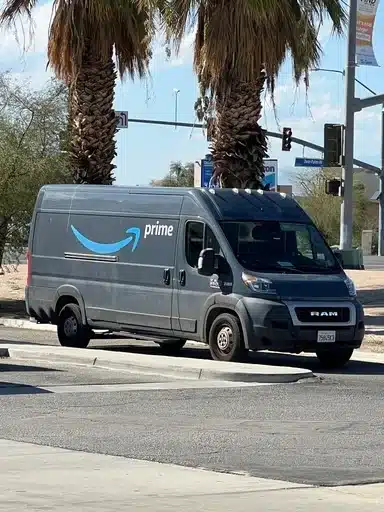
Amazon actively attempts to shield itself from liability when its trucks cause accidents. Most drivers in those familiar blue vans do not actually work for Amazon. Instead, they work for Delivery Service Partners (DSPs), which are separate contracting companies. Following a crash, Amazon will immediately argue that the DSP is an independent contractor and that Amazon bears no liability.
Despite these claims, courts are increasingly holding Amazon responsible. Legal theories like agency and retained control apply because Amazon exerts immense oversight over DSP drivers. Through apps like Rabbit, Amazon tracks delivery speed as well as monitors hard braking and routing in real time. If a company controls how a worker performs their job, they can often be held legally liable for the worker’s mistakes.
Additionally, Amazon Flex utilizes gig workers who drive their personal vehicles. In these situations, liability depends heavily on the specific circumstances of the crash and the driver’s activity at the exact moment of impact.
What to Do After a Delivery Vehicle Crash in Clark County
Protecting your rights begins at the accident scene. You must get medical care immediately, even if your injuries seem minor at first. Delaying medical treatment gives corporate insurance adjusters an excuse to deny your claim.
Gather as much specific information as possible from the driver. You need their name, license number, vehicle number, and the exact name of their delivery company. Take photographs of the truck, focusing closely on the license plate and any corporate logos or DOT numbers printed on the doors. You should also report the accident to the delivery company to create an official record. Under no circumstances should you accept a quick settlement offer before speaking with legal counsel.
The Nevada Statute of Limitations for Injury Claims
Time is a critical factor in any Nevada personal injury case. Under Nevada Revised Statutes 11.190(4)(e), you usually have two years from the date of the accident to file a personal injury lawsuit. If you miss this strict deadline, the court will permanently dismiss your claim, regardless of how severe your injuries are. Nevada also provides a three-year deadline for property damage claims under NRS 11.190(3)(c).
While two years sounds like plenty of time, waiting is dangerous. Crucial evidence begins disappearing within hours. Commercial surveillance footage that could prove the driver was speeding is often overwritten every 24 to 72 hours. Physical hazards are cleared, and witnesses forget key details. Acting quickly allows your legal team to secure the telematics and route data from the delivery truck before it is erased.
Frequently Asked Questions
Can I sue the delivery company if the driver is a contractor?
Yes, it is possible. Even if a driver is classified as an independent contractor, the parent company can sometimes be held liable if it retained operational control over the driver’s work or if it negligently hired an unsafe contracting company.
Does commercial insurance cover my medical bills?
Yes. Delivery companies and their designated contractors are required to carry substantial commercial insurance policies, often exceeding one million dollars in coverage. These policies are designed to cover economic damages, such as medical expenses, rehabilitation costs, and lost wages.
Will Amazon pay if an Amazon Flex driver hits me?
If an Amazon Flex driver is actively engaged in a delivery at the time of a collision, Amazon provides a commercial auto insurance policy that applies to the crash. If the driver had the app off, their personal auto insurance would be the primary source of compensation.
Contact Paul Padda Law for Help
Taking on a massive logistics corporation and its aggressive insurance adjusters is not something you should face alone. You deserve time to recover with your family while professionals handle the legal burdens. We understand the physical and financial stress a severe accident causes, and we are prepared to evaluate every detail of your case to hold the right parties accountable.
If you or a loved one has been injured by a delivery vehicle, reaching out early makes a significant difference in preserving crucial evidence. Call Paul Padda Law today at 702-707-7000 to speak with our team about your situation and your options moving forward.